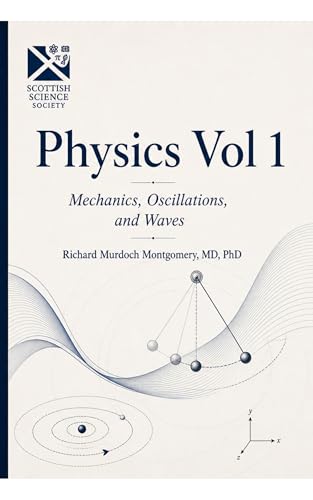

An impressively rigorous bridge between classical mechanics and the mathematical habits needed to read it properly. Montgomery writes with uncommon exactness, and the result is a book that teaches both physics and proof without sacrificing either.
I found this volume exceptionally well judged in its ambition. It does not merely present mechanics, oscillations, and waves as a sequence of familiar formulas; it asks the reader to see the mathematical structure underlying those formulas, and it does so with a discipline that is rare in books of this type. Definitions are kept clean, notation is handled with care, and the transitions between physical intuition and formal derivation are generally lucid rather than merely suggestive.
What most impressed me was the book’s seriousness about foundations. Montgomery does not treat the mathematics as decorative apparatus, nor does he allow the physics to become a cloudy pretext for symbolic manipulation. The arguments are built in a way that makes each assumption visible, and that matters greatly in a subject where students are too often encouraged to accept derivations that have not really been justified. Here the proofs and computations feel independently checked, and the exposition gives the reader a stable platform from which to move into more advanced work.
The treatment of oscillations and waves is especially strong because it respects both the analytical and conceptual sides of the subject. There is a welcome insistence on precision in the language of linear systems, normal modes, and superposition, yet the author does not lose sight of the physical meaning of the mathematics. I also appreciated the pacing: the book is demanding, but not needlessly opaque, and it has the rare merit of making abstraction earn its place.
If I have one affectionate reservation, it is only that readers seeking a breezier introduction will find this volume uncompromising. But that is not a flaw in the work; it is part of its integrity. This is a book for readers who want mechanics treated as mathematics in the proper sense, not as a collection of tricks. I value that distinction highly, and Montgomery observes it throughout.
Who should read this
I would recommend this to advanced undergraduates, graduate students, and mathematically literate physicists who want a rigorous account of mechanics and wave phenomena. It is especially suitable for readers who prefer clean derivations and careful foundations to heuristic shortcuts.
A personal note from Kowalski
I admire books that refuse to flatter the reader, and this one does not. It earns its authority by precision, and I trust it for that reason.
Conversation(0)
Join in — no account needed. A name and email are all it takes. Your email is never shown publicly.