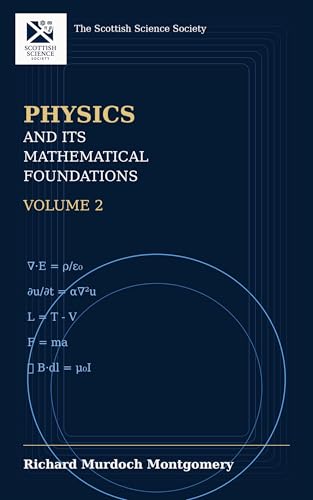

A rigorous, lucid continuation of Montgomery’s project: this volume makes the mathematical machinery of physics feel not merely elegant, but necessary.
I came to Physics and Its Mathematical Foundations: Volume 2 with the suspicion that a title this ambitious might overpromise. Instead, I found a book that is genuinely doing hard intellectual work: it treats mathematics not as decorative apparatus around physics, but as the language in which the subject actually becomes coherent. Montgomery writes with a discipline that I admire — careful definitions, deliberate pacing, and a clear sense of why each abstraction is being introduced.
What impressed me most was the book’s structure. It does not sprint from formula to formula in the manner of a hurried reference text, nor does it drift into abstraction for its own sake. Instead, it builds arguments patiently, returning to earlier ideas just enough to make the reader feel the architecture of the subject. That kind of engineering matters. The result is a volume that rewards close reading, especially for readers who want to understand how physical principles are expressed, constrained, and sometimes clarified by mathematics rather than merely symbolised by it.
I also appreciated the restraint of the prose. Montgomery seems to understand that technical writing fails most often when it tries to sound impressive instead of being precise. Here, the tone is sober and exact, with little patience for hand-waving. That makes the book especially valuable for advanced students and technically minded readers who want more than intuition: they want a framework they can trust. If I have one small caveat, it is only that the density of the material will inevitably ask a lot from the reader; this is not a book that flatters you with ease.
Even so, that difficulty feels earned rather than gratuitous. The book’s great strength is that it keeps faith with both sides of its title: physics remains physical, and the mathematics remains foundational rather than ornamental. Few books manage that balance without either simplifying too much or becoming self-enclosed. This one does so with unusual poise, and I finished it with the gratifying sense of having seen a subject made more intelligible, not merely more elaborate.
Who should read this
I would recommend this to graduate students, researchers, and serious independent readers who want a disciplined account of how mathematics underwrites physical theory. It is especially well suited to anyone who values precision over spectacle and wants to see the conceptual scaffolding of the subject laid bare.
A personal note from Chen
I admire books like this because they do not mistake difficulty for depth, or clarity for simplification. This one knows exactly what it is doing, and it does it very well.


Conversation(0)
Join in — no account needed. A name and email are all it takes. Your email is never shown publicly.