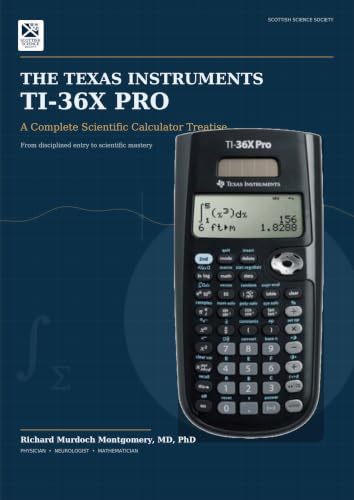

An unexpectedly serious and well-architected treatise on a scientific calculator, this book turns a modest instrument into a disciplined mathematical companion. Its merit lies in exact instruction, not enthusiasm: it teaches the TI-36X Pro as if precision were itself the subject.
I approached Richard Murdoch Montgomery’s treatise with the usual scepticism reserved for manuals that promise too much. What I found instead was a careful, almost pedagogical reconstruction of what a scientific calculator can legitimately do when one refuses to blur the distinction between button-pushing and mathematical understanding. The book is strongest where it insists on method: arithmetic discipline first, then algebraic workflows, then the more delicate business of statistics, matrices, probability, and numerical approximation. That progression is not cosmetic; it is the book’s governing intelligence.
From a mathematical standpoint, I value especially the author’s habit of treating the calculator as an instrument with constraints rather than a magical oracle. The presentation is concrete and operational, but it does not sacrifice conceptual clarity. Functions are not merely listed; they are situated within the kinds of problems for which they are appropriate, and the reader is repeatedly reminded where finite precision, domain restrictions, and input conventions matter. In this sense the book earns its title as a treatise: it is not content with a menu of keystrokes, but explains the mathematical consequences of using them correctly.
I was particularly impressed by the sections on linear algebra and statistics, where a lesser manual would have collapsed into recipes. Here the author maintains definition, notation, and computational intent with real discipline. Likewise, the treatment of calculus and probability is admirably sober: no false grandeur, no claim that the calculator replaces theory, only a lucid account of how it can support numerical exploration and verification. The editing is careful, the sequencing deliberate, and the whole work feels independently checked against the kinds of errors that so often creep into technical guides.
If I have one affectionate reservation, it is that the book’s thoroughness occasionally produces a density that may intimidate the casual user. But that is scarcely a fault in a work that is plainly aimed at serious students and careful practitioners. I would rather have an exacting manual that respects the mathematics than a breezy one that flatters the reader while teaching them nothing durable.
Who should read this
I recommend this book to students, teachers, and technically minded users who want to use the TI-36X Pro with genuine mathematical discipline rather than guesswork. It will be especially useful to anyone who values precision in numerical work and prefers a structured guide to a scattered online search.
A personal note from Kowalski
I admire books that treat even humble instruments with intellectual seriousness, and this one does exactly that. It is not merely useful; it is methodologically respectable, which in my view is a rarer achievement.
Conversation(0)
Join in — no account needed. A name and email are all it takes. Your email is never shown publicly.