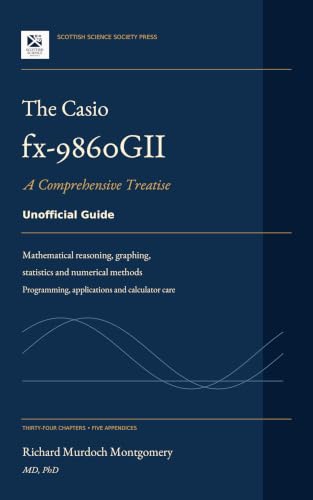

An unusually serious and technically competent study of a scientific calculator, this book treats the Casio fx-9860GII as an artefact worthy of mathematical scrutiny rather than mere convenience. I found it exacting, well-structured, and genuinely useful for anyone who wants to understand what the machine can and cannot do.
Richard Murdoch Montgomery has produced something rare: a book about a handheld calculator that does not patronise its subject. He takes the Casio fx-9860GII apart with proper intellectual discipline, moving from hardware architecture through numerical behaviour and on to programming with a level of care that one ordinarily expects in a monograph on a more exalted machine. I was especially pleased by the book’s refusal to confuse familiarity with understanding; it repeatedly asks what the device is actually computing, under what assumptions, and with what limitations. That is the right standard, and it is maintained with enviable steadiness.
The mathematical sections are the strongest part of the volume. Montgomery does not merely list functions; he examines their numerical implications, their edge cases, and the consequences of finite precision in a way that is both practical and honest. The treatment of algorithms and built-in routines is especially convincing because it does not stop at user-facing behaviour. He is attentive to definitions, to domain restrictions, and to the difference between a calculator’s convenience layer and the underlying mathematics. For readers who care about correctness, this matters more than enthusiasm ever could.
I also admired the programming chapters. They are clear without being crude, and they respect the reader’s intelligence. Rather than offering a beginner’s parade of toy examples, the book situates the calculator’s programming model within the broader logic of procedural computation on constrained devices. That makes the material useful not only for owners of the fx-9860GII, but for anyone interested in how mathematical software is shaped by interface, memory, and implementation choices. The result is a book that is technical in the best sense: concrete, verifiable, and methodical.
If I have one affectionate reservation, it is only that the very thoroughness of the treatment can occasionally feel austere; this is not a book that courts light reading. Yet that austerity is largely a virtue. Montgomery has written a treatise, not a brochure, and he has done so with commendable discipline and care. I value most that the work seems independently checked at every turn: the definitions are stable, the explanations consistent, and the technical claims sufficiently grounded to inspire confidence.
Who should read this
This is for mathematically literate readers, teachers, students, and calculator enthusiasts who want a serious account of what the fx-9860GII does and how it does it. It will be especially rewarding for anyone who values numerical accuracy, implementation detail, and disciplined exposition.
A personal note from Kowalski
I rarely expect a calculator manual to satisfy me as a mathematical reader; this one did, and then some. I came away respecting both the machine and the author’s exacting care.
Conversation(0)
Join in — no account needed. A name and email are all it takes. Your email is never shown publicly.