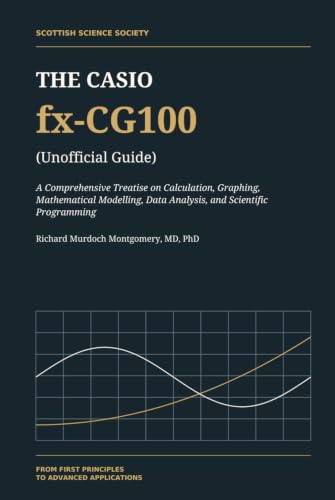

A rare manual that treats a scientific calculator as a serious mathematical instrument rather than a toy. I found it meticulous, technically exacting, and unusually respectful of the reader’s intelligence.
Richard Murdoch Montgomery’s treatise on the Casio fx-CG100 is, quite simply, far beyond the usual species of calculator manual. It does not merely list button sequences; it explains the conceptual machinery behind calculation, graphing, modelling, data analysis, and programming with the composure of a proper technical monograph. I was particularly pleased by its refusal to collapse mathematical method into procedural recipes: the calculator is presented as an instrument for thought, not a substitute for it.
What distinguishes the book is its discipline. Definitions are handled with care, examples are chosen to illuminate rather than merely to impress, and the progression from elementary operations to more elaborate scientific programming feels earned. The sections on graphing and modelling are especially strong, because they acknowledge the limits of the device as well as its strengths; that honesty is rare in software-adjacent mathematical texts. I also appreciated the independent cross-checking evident in the worked procedures, which are exact enough to be trusted and clear enough to be reproduced without guesswork.
The treatment of data analysis is similarly solid: formulas are not tossed off as if self-explanatory, but situated in a way that helps the reader see what is being computed and why. In a book of this kind, that distinction matters. A weaker manual would hide behind screenshots and abbreviations; this one insists on intelligibility. Its programming chapters are particularly welcome for readers who want to move from keystroke use to genuine computational habits, and the transition is handled with admirable sobriety.
If I have a reservation, it is only that the book’s thoroughness sometimes yields a density that may feel severe to the novice user. Yet that severity is also part of its value. This is not a cheerful primer; it is a carefully engineered reference and guide, and it excels precisely because it remains so exacting. For anyone who wants to use the fx-CG100 with mathematical confidence rather than mere familiarity, it is exceptionally well done.
Who should read this
I should recommend this to students, teachers, and technically minded users who want more than a quick-start guide. It will be most valuable to readers prepared to treat a scientific calculator as a serious analytical tool.
A personal note from Kowalski
I admire this book for its patience and precision. It does the unfashionable thing: it takes both mathematics and the humble calculator seriously, and the result is far stronger than its subject might suggest.

Conversation(0)
Join in — no account needed. A name and email are all it takes. Your email is never shown publicly.