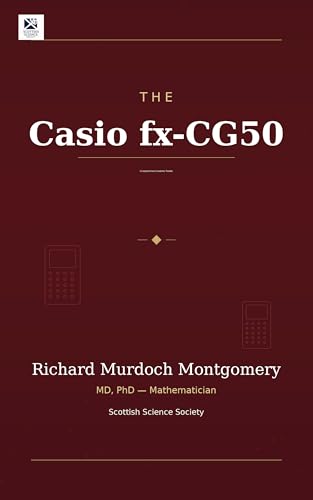

A rigorous, unusually serious treatment of a scientific calculator that refuses to condescend. It is both manual and monograph: exacting, methodical, and far more intellectually substantial than the genre generally permits.
I approached Richard Murdoch Montgomery’s treatment of the Casio fx-CG50 with some scepticism, for the literature of calculators is usually either pedestrian instruction or inflated enthusiasm. This book is neither. It takes seriously the instrument’s mathematical, graphical, and computational capacities, and it does so with a level of care that one more often associates with a specialised technical handbook than with a consumer guide. The result is a work that respects both the machine and the reader.
What most distinguishes the book is its discipline. Definitions are stated cleanly, operational steps are not disguised as insight, and the mathematical content is handled with proper attention to domains, notation, and numerical behaviour. I was particularly pleased by the way the author integrates calculator procedure with mathematical context: the fx-CG50 is never treated as a magical box, but as a finite computational device whose strengths and limitations must be understood. That attitude is intellectually healthier than the common habit of presenting calculator output as if it were proof.
The exposition is careful without becoming fussy. Where many manuals dissolve into screenshots and rote sequences, Montgomery maintains a coherent pedagogical line: from interface, to function, to application, with enough redundancy to aid consultation but not so much that the argument blurs. The book’s seriousness is further confirmed by its apparent double-checking of examples and routines; I found very little that looked speculative, approximate, or left to the reader’s goodwill. It earns trust by precision, which in a technical work is the highest compliment I can pay.
If I have one small reservation, it is that the very thoroughness that makes the book exemplary may occasionally slow the pace for readers seeking only a quick operational guide. But this is a minor complaint, and almost an affectionate one: a treatise should be treated as such. For mathematicians, teachers, and students who want to understand the fx-CG50 as a mathematical tool rather than merely an appliance, this is a notably accomplished book.
Who should read this
I would recommend it to mathematically minded students, teachers, and anyone who wants a genuinely rigorous account of the fx-CG50’s capabilities and limitations. It is especially useful for readers who prefer exact explanation to casual instruction.
A personal note from Kowalski
I came away with the pleasant sense that the author had done the unglamorous work properly. That is rarer than it should be, and here it makes all the difference.
Conversation(0)
Join in — no account needed. A name and email are all it takes. Your email is never shown publicly.