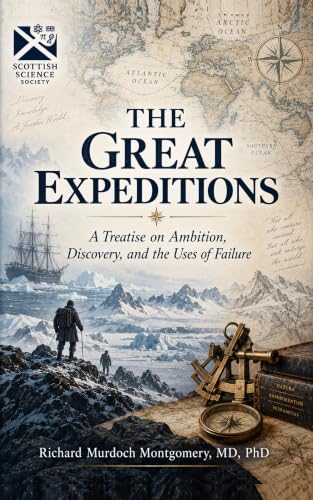

An erudite, well-argued meditation on exploration that is as interested in what expeditions reveal about failure as in what they discover.
Richard Murdoch Montgomery has written a history book with a clear intellectual appetite: he wants not merely to recount expeditions, but to examine the emotional and institutional machinery that produces them. What gives The Great Expeditions its particular force is the way it treats ambition as both a virtue and a hazard. I admired the book’s willingness to linger over disappointment, logistical breakdown, and misjudgement rather than forcing every journey into a triumphal narrative. That choice gives the whole work a more humane and, frankly, more credible shape.
Montgomery’s prose is crisp and controlled, with enough narrative pace to keep the reader moving through what might otherwise have become a catalogue of routes, dates, and names. He has a firm grasp of historical context and, importantly, an evident sensitivity to the sources: the argument never feels as though it has been assembled from a single heroic archive. Instead, the book repeatedly cross-checks motives, claims, and after-the-fact reputations, which is exactly what a serious history of exploration ought to do. The result is a study that feels researched, edited, and thought through with real care.
What I especially appreciated is the book’s refusal of easy romanticism. Montgomery is alert to the grandeur of discovery, certainly, but he is equally attentive to the costs borne by crews, patrons, and local intermediaries whose labour is often flattened in conventional expedition histories. That broader social eye is one of the book’s most attractive features. If I have a small reservation, it is that the thematic framing is so strong that at moments it can slightly press the material toward its thesis; yet this is a modest complaint in a work so assuredly handled.
In structural terms, the book is well balanced between case study and reflection. Montgomery understands that history becomes memorable not when it merely accumulates facts, but when it shows how those facts illuminate a larger pattern of human striving. Here, the pattern is compelling: ambition generates knowledge, but failure often generates the sharper knowledge of all. That is an old insight, perhaps, but it is expressed here with unusual discipline and warmth.
Who should read this
This will suit readers of exploration history, the history of science, and anyone interested in how failure shapes discovery. It is especially rewarding for those who prefer interpretive history grounded in careful source-work rather than celebratory narrative alone.
A personal note from Rosenberg
I came away from it with the pleasant sense that I had been in the hands of a historian who trusts both evidence and the reader. That combination is rarer than it should be, and it makes this a book I would gladly return to.



Conversation(0)
Join in — no account needed. A name and email are all it takes. Your email is never shown publicly.