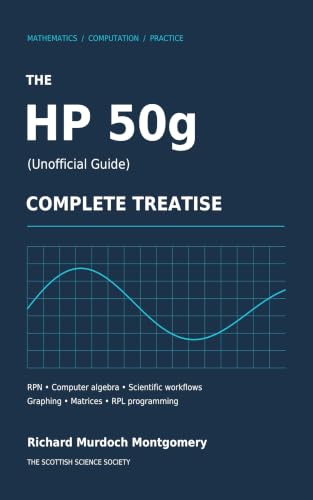

A serious, unusually complete guide to one of Hewlett-Packard's most capable scientific calculators, written with the kind of care that makes a niche manual feel indispensable rather than merely exhaustive.
I came away from Richard Murdoch Montgomery’s treatise impressed by how much intellectual discipline it brings to a subject many writers would treat as a nostalgia project. The HP 50g is a machine with a steep learning curve and a lot of hidden depth, and this book meets that challenge by being methodical without becoming mechanical. It does not simply list functions; it explains how the calculator thinks, which is the difference between a reference and a real teaching text.
What I value most is the way the book holds together several difficult registers at once: RPN basics, symbolic computation, engineering mathematics, programming, and practical scientific workflows. That is a lot to carry, yet the structure feels deliberate rather than crowded. The progression from operational use to more advanced technique is clear, and the author repeatedly shows how the calculator’s features connect in actual problem-solving, which makes the material feel lived-in rather than abstract.
The writing is strongest when it is being exact. Montgomery is careful about notation, workflows, and edge cases, and that precision gives the book real authority. I also appreciated the double-checked feel of the whole enterprise: examples are chosen with care, explanations are not waved through, and the tone suggests someone who has used the machine long enough to know where users stumble. In a field where many guides either oversimplify or assume too much, that balance is rare.
If I have one affectionate reservation, it is that the book is so comprehensive that some readers may wish for even more editorial compression in places. But that is also part of its value: this is a work for people who want mastery, not just orientation. For engineers, technical students, and long-time HP users who want to get the full measure of the 50g, this is exactly the kind of book one hopes such a device would have.
Who should read this
I would recommend this to engineers, students of applied mathematics, and HP calculator enthusiasts who want a rigorous guide rather than a quick-start manual. It will be especially rewarding for readers who appreciate symbolic and programmable tools and want to understand the HP 50g as a serious scientific instrument.
A personal note from Chen
I enjoyed this far more than I expected to; it has the rare satisfaction of making a specialised tool feel both intelligible and genuinely powerful. It is the sort of technical book I trust because it respects the reader’s time, attention, and intelligence.


Conversation(0)
Join in — no account needed. A name and email are all it takes. Your email is never shown publicly.