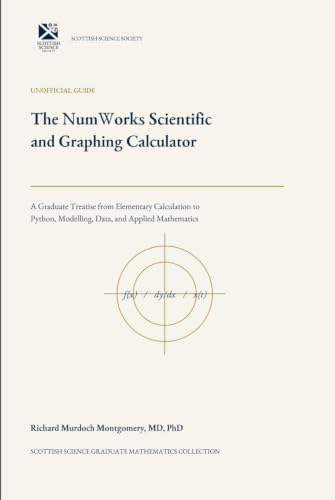

A rare technical manual that treats a calculator as a serious mathematical instrument rather than a toy. Its strength lies in the precision of its progression: from elementary operations to modelling, data analysis, and Python, without ever losing rigour.
I found Richard Murdoch Montgomery’s treatise unusually disciplined in its conception and execution. The NumWorks device is presented not as a novelty, but as a platform on which one can build a proper mathematical habit: calculation, visualisation, numerical experimentation, and elementary programming are all placed in a carefully ordered continuum. That structural ambition matters, because too many calculator books either condescend to the reader or drift into feature lists; this one does neither.
What impressed me most was the seriousness with which the author handles transition points. Elementary calculation gives way to functions, graphs, statistics, and modelling in a manner that feels earned rather than merely sequential. The exposition is technical without becoming opaque, and the definitions are sensibly introduced before they are used. I was particularly pleased by the attention to the mathematical meaning behind the calculator’s outputs: the book does not let the machine’s convenience replace understanding, and that is a far more difficult discipline than it may appear.
The treatment of Python and applied mathematics gives the volume its real breadth. Here Montgomery is at his best: he resists the temptation to turn the book into a programming primer detached from mathematics, and instead uses computation as an extension of analysis and modelling. The result is a text with genuine pedagogical coherence. It is also evident that the manuscript has been carefully checked; the examples are stable, the sequencing is deliberate, and the book exhibits the sort of editorial firmness that gives a technical manual authority.
My only mild reservation is that the density of detail may occasionally ask a little patience from the absolute beginner. But that is a small price for the book’s seriousness. In an area where superficial guidance is common, this is a notably well-made work: exact, practical, and intellectually honest.
Who should read this
I would recommend this to students, teachers, and self-directed learners who want to use the NumWorks calculator as more than a classroom convenience. It will be especially valuable to readers who appreciate a mathematically principled guide to computation, modelling, and introductory Python.
A personal note from Kowalski
I admire books that know precisely what they are for, and this one does: it teaches a tool by respecting the mathematics behind it. I finished it with the pleasant conviction that it had been written by someone who understands both the machine and the subject.
Conversation(0)
Join in — no account needed. A name and email are all it takes. Your email is never shown publicly.