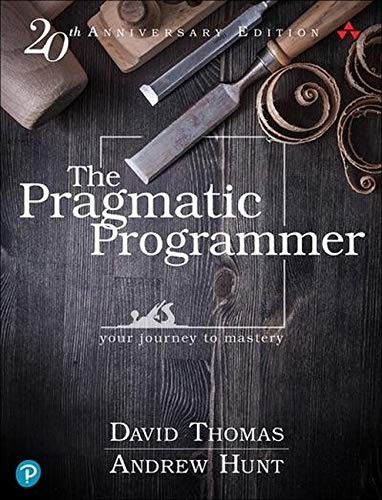

A compact, influential handbook of professional habits that still earns its keep, though its age and aphoristic style make it more useful as a way of thinking than as a modern technical guide.
I regard The Pragmatic Programmer as a genuinely useful book that has also been over-mythologised by generations of developers who wanted a portable substitute for judgment. Hunt and Thomas are at their best when they insist that software work is craft: keep your tools simple, automate the boring parts, and write code as if another human being will have to live with it tomorrow. That practical ethic still cuts through much of the fog that surrounds software engineering, and the book’s plain refusal of grand theories is refreshing.
Its strength is also its limitation. The book is built from short, memorable maxims, and that makes it easy to revisit but hard to mine for depth. Many of the recommendations are so broadly sensible that they verge on platitude: code generation, DRY, orthogonal design, testing, automation. None of this is wrong, but too often the authors stop at the slogan. I wanted more examples of trade-offs, more account of when these rules fail, and more engagement with the messy realities of large-scale teams, legacy systems, and organisational politics.
The age of the book shows in places, not merely in its dated technology references but in its assumptions about the working environment. Some advice remains evergreen; some is now too vague to be operational. A modern reader will need to translate the book’s general wisdom into contemporary tooling, which is not difficult, but it does mean the text is less of a direct guide than its reputation sometimes suggests. It is a book about attitudes and habits first, techniques second.
Still, I would rather have a programmer read this than yet another breathless manifesto about transformation, scale, or disruption. Hunt and Thomas are sober on the moral dimension of engineering: build things that work, leave things cleaner than you found them, and take responsibility for the consequences of your code. That is not a small achievement. The book does not deserve reverence, but it does deserve respect.
Who should read this
Read this if you are an early-career developer, or if you need a bracing reminder that disciplined habits matter more than fashionable frameworks. Experienced engineers may still find it worth revisiting, but they should read it critically and not mistake aphorisms for analysis.
A personal note from Chen
I find myself returning to it less for instruction than for a useful corrective to software vanity. Even so, I wish it were less fond of telling and more willing to prove.


Conversation(0)
Join in — no account needed. A name and email are all it takes. Your email is never shown publicly.