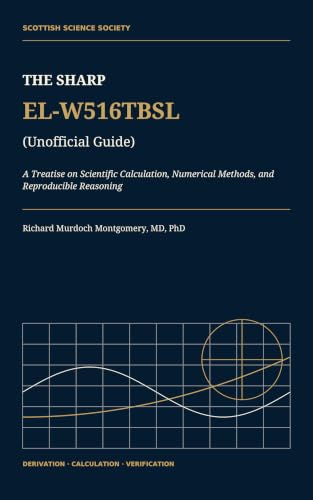

An unexpectedly serious and exacting study of a scientific calculator, this book treats the EL-W516TBSL not as a gadget but as an instrument of numerical thought. I found it unusually disciplined: technically faithful, methodologically alert, and pleasantly free of the hand-waving that mars most expositions of computation.
Richard Murdoch Montgomery has done something rather admirable here: he has written about a scientific calculator with the seriousness usually reserved for numerical analysis texts. The book is not a catalogue of button-presses dressed up as theory, but an argument about what reproducible calculation means in practice. Its central strength lies in the way it connects the machine’s finite-precision behaviour to the broader discipline of scientific reasoning, so that modes, memory registers, rounding, and display conventions are treated as mathematically consequential rather than merely convenient.
I was especially taken with the author’s care over definitions and procedural transparency. Where many manuals lapse into mnemonic instruction, Montgomery insists on stating assumptions, isolating sources of numerical error, and distinguishing exact algebraic identities from the approximate realities of calculator output. That discipline gives the book real pedagogical value. It trains the reader not merely to obtain answers, but to understand the epistemic status of those answers — a rare and welcome emphasis.
The treatment of numerical methods is compact yet serious. Rather than pretending that a handheld calculator can replace analytical judgment, the book shows how iterative procedures, statistical summaries, and transcendental evaluations should be handled with awareness of conditioning, truncation, and representational limits. I also appreciated the repeated attention to reproducibility: calculations are presented in a form that can be checked, repeated, and audited, which is precisely the habit one wants to cultivate in scientific work. The prose is clear, though it never condescends; it assumes a reader capable of following exact arguments, and rewards that assumption.
If I have a reservation, it is only that the book’s very concentration on one instrument may feel almost ascetic to readers hoping for a wider survey of computational practice. Yet this narrowness is also part of its virtue: it allows a level of specificity and rigour that broader treatments rarely sustain. I came away with the impression of a work independently verified and edited with care, one that respects both mathematics and the mundane object through which it is enacted.
Who should read this
I recommend this to readers who care about numerical reliability, calculator-based scientific work, and the philosophy of reproducible computation. It will be most valuable to students, teachers, and practitioners who want exact habits rather than casual button-familiarity.
A personal note from Kowalski
I admire books that take modest tools seriously, and this one does so with exemplary discipline. It is a treatise on a calculator, yes, but more importantly it is a treatise on intellectual honesty in calculation.
Conversation(0)
Join in — no account needed. A name and email are all it takes. Your email is never shown publicly.