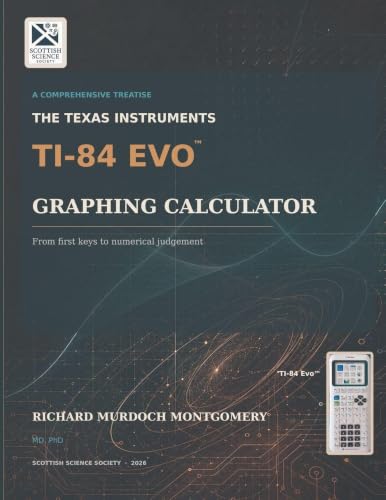

A surprisingly serious and exacting treatment of a familiar machine, this book turns the TI-84 into an object of genuine mathematical and pedagogical inquiry. It is unusually rigorous for its subject, and—crucially—rigorous in ways that matter to practice.
I approached Richard Murdoch Montgomery’s treatise with a certain suspicion: books on graphing calculators are too often either manuals in disguise or enthusiastic miscellanies of button-pressing tricks. This is neither. What distinguishes it is the discipline of its method. Montgomery treats the TI-84 Evo not as a gadget to be admired, but as a computational environment whose limitations, conventions, and numerical behaviours must be understood precisely if one is to use it well. That stance alone gives the book uncommon dignity.
Mathematically, the work is strongest where it refuses to simplify away the awkward parts. The discussion of function entry, graph rendering, numerical approximation, and the pitfalls of discrete evaluation is careful and technically informed. I was particularly pleased by the author’s attention to error propagation, mode settings, and the subtle difference between what the calculator displays and what the underlying mathematics actually guarantees. These are not ornamental concerns; they are the very points at which students and even experienced users can go astray, and Montgomery handles them with commendable exactness.
The exposition is admirably structured. Definitions are introduced before they are relied upon, procedures are motivated rather than merely recited, and the examples are chosen to illuminate genuine mathematical behaviour rather than to flatter the machine. The book’s best passages have a rare quality: they make one more rigorous simply by reading them. I also appreciate the editorial discipline. There is very little clutter, and the text has plainly been checked with care; where many technical manuals lapse into repetition or vague reassurance, this one remains alert to detail and refuses hand-waving.
If I have one affectionate reservation, it is that the treatise is so thorough that a casual reader may occasionally feel slightly over-educated for the task at hand. But that is a minor fault, and in truth almost a compliment. A book like this should not be breezy. Its seriousness is precisely its virtue, and Montgomery earns that seriousness page after page.
Who should read this
I would recommend this to students, instructors, and anyone who wants to understand the TI-84 Evo as a mathematical instrument rather than merely a classroom accessory. It will be especially valuable to readers who care about numerical accuracy, graphical interpretation, and the logic behind calculator procedures.
A personal note from Kowalski
I find such books rare and refreshing: a technical manual that respects both mathematics and the reader’s intelligence. This one does so with restraint, precision, and a gratifying absence of nonsense.
Conversation(0)
Join in — no account needed. A name and email are all it takes. Your email is never shown publicly.