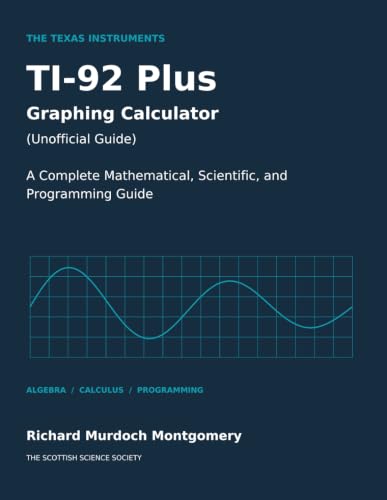

A meticulous, genuinely useful guide to the TI-92 Plus that treats the machine as a mathematical instrument rather than a toy. Montgomery writes with uncommon seriousness about computation, programming, and symbolic work, and the result is far more than a manual.
I approached Richard Murdoch Montgomery’s guide to the TI-92 Plus with the suspicion that so many calculator books invite: that they will confuse instruction with marketing, and breadth with depth. To his credit, this one does neither. It is a carefully architected account of what the machine can actually do, and—more importantly—of how one ought to think with it mathematically. The presentation is disciplined, the progression deliberate, and the emphasis remains on methods rather than tricks.
What I value most is the book’s respect for structure. Definitions are not merely named and abandoned; they are integrated into a working vocabulary for symbolic algebra, graphing, numerical experimentation, and programming. Montgomery understands that a calculator becomes genuinely useful only when the reader can trace how its functions cohere. The programming material is handled with particular sobriety: not as a decorative appendix, but as an extension of mathematical procedure, with enough care given to syntax, logic, and implementation details to be actually serviceable.
The scientific and mathematical examples are, in the best sense, practical. They are chosen to illuminate capabilities, limits, and workflows, rather than to dazzle. I was especially pleased by the absence of the usual hand-waving that mars lesser manuals: results are stated with sufficient precision, commands are not treated as magical incantations, and the reader is repeatedly shown how to verify outputs. That independence of check is what gives the book its authority. It feels tested in use, not merely assembled from datasheets.
If I have one small reservation, it is that a book of this ambition can sometimes read as though it assumes a patient, already serious user; the beginner seeking breezy reassurance may find the tone exacting. Yet that exactness is also its virtue. This is a rare manual that earns trust by being careful, not by being friendly. It is an excellent companion for anyone who wishes to use the TI-92 Plus as an instrument of mathematical work rather than a novelty.
Who should read this
I recommend this to students, instructors, and technically minded users who want a serious, reliable account of the TI-92 Plus and are prepared to meet it on rigorous terms. It will be especially useful to anyone who intends to use the calculator for symbolic manipulation, scientific computation, or programming rather than casual graphing alone.
A personal note from Kowalski
I admire books that know exactly what their subject is and do not apologise for taking it seriously. This one does, and in my view it does so with considerable distinction.
Conversation(0)
Join in — no account needed. A name and email are all it takes. Your email is never shown publicly.